When Is My Saturn Return? Your Exact Dates, Your Age, and What Happens to Everyone at 29
Your birth date gives the days Saturn crosses its birth position, whether it crosses once or three times, and the rest of your life in Saturn cycles.
Loading calculator…
One crossing or three
The dates at the top are the moments Saturn returns to the exact degree it held when you were born. Saturn spends part of every year moving backward against the stars, and whether that backward loop lands on your degree decides how many dates you get. For about 37 in 100 birthdays the loop lands on it, and Saturn crosses three times: forward, back, forward again. For the rest it crosses once.
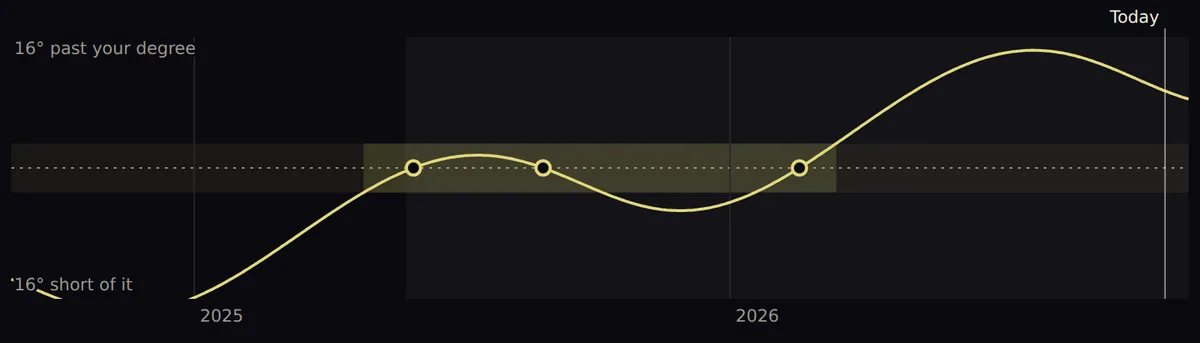
The chart under the dates draws that loop as Saturn’s distance from your degree over time. Someone born April 10, 1996 has Saturn at 0°22′ Aries; the line reaches zero on May 30, 2025, turns around on July 13 only 1.6° later, drops back through zero on August 26, and crosses for the last time on February 17, 2026. Someone born June 15, 1997 gets a single crossing on April 14, 2027, because Saturn’s turn that year came 2.5° away from their degree.
Three windows, and where “27 to 30” comes from
The three rows under the chart are three ways people date a Saturn return. Exact crossings are pure astronomy. The peak is the stretch when Saturn sits within 3° of your degree, and it lasts 10 to 11 months for 8 in 10 people born between 1940 and 2009. The widest window runs from the day Saturn enters your Saturn sign until it leaves, usually close to three years.
That widest window is where the familiar “27 to 30” comes from: Saturn enters a person’s Saturn sign anywhere from age 26.1 to 29.9, while the first exact crossing always falls between 28.4 and 29.9, most often around 29 years and 2 months.
Without a birth time the calculator works from the whole calendar day, and the dates can move by a few days; for April 10, 1996 the spread is under four days. For about 2 in 100 birthdays Saturn stops so close to the birth degree that the time of day decides between one crossing and three, and the result says so and asks for the time. The time zone list applies the daylight saving rules in force on your birth date.
The note under the three rows also lists the birth dates that share your Saturn degree to within half a degree. Their exact crossings fall within days of yours; for April 10, 1996 that is everyone born April 6 to 14, 1996, and November 16 to December 20, 1996.
Your life in Saturn cycles
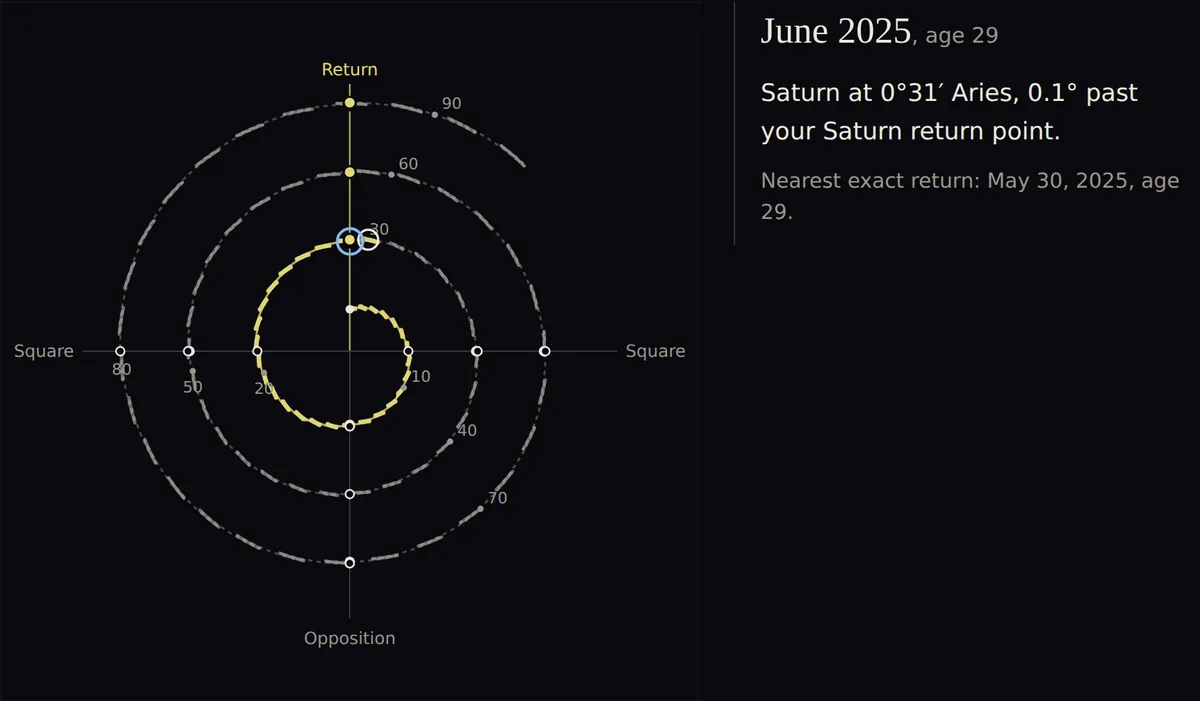
The spiral starts at your birth in the middle and winds outward one loop per Saturn cycle of about 29.5 years. Its angle is Saturn’s real position relative to where it was when you were born, so each return sits on the top ray, the opposition at the bottom, and the two squares at the sides. The small kinks along the line are the yearly backward loops, and a triple crossing shows as the line touching the ray three times.
For April 10, 1996 the first square came at age 7, the opposition at 13 with three crossings in 2009 and 2010, the closing square at 21, the return at 29, and the second return in March 2055 at age 58. Selecting any point on the spiral shows the month, your age, where Saturn stood and how far it was from the nearest of these angles.
Saturn return or just being 29?
The strip under the spiral puts your first return, in gold, on the same age axis as figures for everyone in the United States. The median age at first marriage is 28.4 for women and 30.8 for men. The average first-time mother is 27.6. In 2025 the highest birth rate belonged to women 30 to 34, at 96.3 births per 1,000, ahead of 25 to 29 at 85.7. People born in the early 1980s held 3.3 jobs between 24 and 29 and 2.1 between 30 and 34, and the share who were married rose from 27% at 25 to 53% at 35.
Those are group figures from surveys, not predictions about one person. They sit next to your window so you can see how much of what people call a Saturn return also happens to everyone in the same years.
What 2027 does to your Saturn and your Sun
The last block lists every 2027 date when Saturn makes an exact return, square or opposition to your natal Saturn or crosses or opposes your Sun, and every 2027 eclipse within 3° of either point. The year has an annular solar eclipse on February 6 at 17°38′ Aquarius, a total solar eclipse on August 2 at 9°55′ Leo, and three penumbral lunar eclipses. For April 10, 1996 the only 2027 entry is Saturn crossing that person’s Sun on May 3; when nothing lands, the block says so.
The link button keeps the birth date and time in the address so the same result opens elsewhere, and the calendar button saves the crossings and window edges as all-day events.
Sources
- U.S. Census Bureau, Families and Living Arrangements, December 2, 2025: median age at first marriage.
- National Center for Family and Marriage Research, Mean Age of Mother at First Birth, 2024, from NCHS natality data.
- CDC National Center for Health Statistics, Births in the United States, 2025 (Data Brief 571): birth rates by age.
- U.S. Bureau of Labor Statistics, National Longitudinal Survey of Youth 1997, March 29, 2022: jobs held and partner status for people born 1980 to 1984.
- Saturn and Sun positions: Swiss Ephemeris, checked against Astronomy Engine; eclipse dates and degrees from Swiss Ephemeris.
Planet positions and dates are astronomy. What a Saturn return means is astrology, offered here for reflection and entertainment.
Built by Vitalii C.