Frozen Pipes: Will Yours Freeze Tonight, and When Will They Thaw?
Your ZIP code, the National Weather Service hourly forecast, and one plain action for each place your pipes run — for the next seven nights.
Loading the frozen pipes calculator…
Still flowing tonight: what each part of the page tells you
The row of seven cards appears as soon as the ZIP code loads. Each card is one night, 6 PM to 9 AM local time, with the lowest hourly temperature in the National Weather Service forecast and the number of hours at or below 20°F. The action for each place is set by the low alone. The hour count is shown for context — a night that touches 19°F for an hour and one that sits at 14°F for eight get the same action — and the calculator does not estimate how fast a pipe freezes. A bright bottom edge marks a night that reaches 20°F, a blue one a night between 21 and 32°F. Any cold-weather alert NWS has issued for that night shows on the card, and a night the forecast only partly covers says so.
The four tiles below ask where your water lines actually run: an outdoor faucet, a garage or crawl space or attic or unheated basement, a sink on an outside wall, and the pipes in heated rooms. Each place gets its own answer, because they freeze at different temperatures. For the unheated space you also say whether the pipes are insulated; “Not sure” is counted as not insulated, so not knowing never earns a calmer answer. The heat question — same as daytime, turned down at night, or away from home — only changes the answer for the pipes inside heated rooms, and adds the travel steps to the list.
The cutaway of the house paints every place you picked with the action for the night you have selected. Tap a part of the house and the card beneath it spells out why: the low, the hours at or below 32°F and 20°F, the wind in the cold hours, any NWS alert, and the exact line of the rule that fired. The temperature line in that card shows how the night unfolds hour by hour against the 32°F and 20°F lines, so you can see whether the cold arrives at dusk or only before dawn. On a phone the same actions appear as a list under the picture.
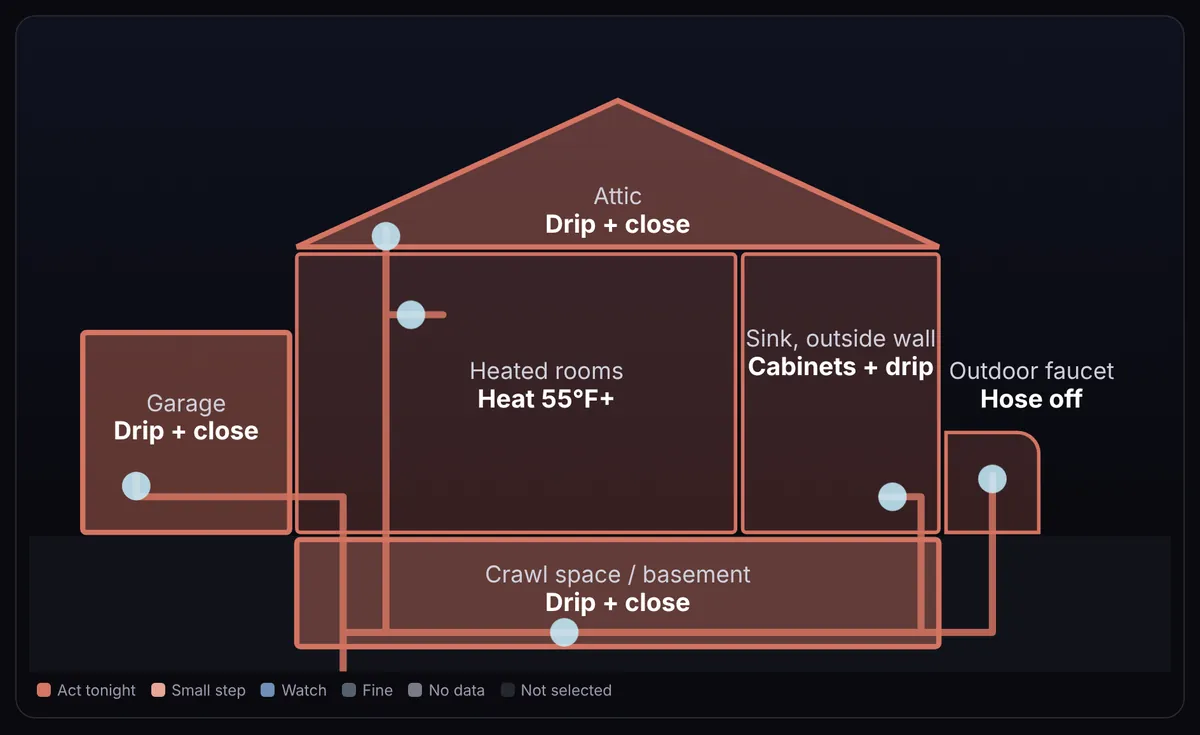
The grid under the cutaway lays the same answers across all seven nights, one row per place, so you can follow the garage through the week or compare the whole house on one night. A night with a 14°F low and eight hours at or below 20°F puts every unheated pipe on “Drip + close”, while a 26°F night after it drops the same uninsulated garage line to “Watch” — the 20°F threshold, not the freezing point, is what moves it. Switch the answer to “Insulated” and those 21–32°F nights turn to “Fine”, but the 14°F night does not change: the 20°F threshold applies to every unheated space on the list.
The list at the bottom turns the selected night into steps in the order the cold arrives. Times come from the forecast itself: “Before 6:00 PM” means the first hour forecast at 32°F, and the drip step uses the first hour at 20°F. Tick items off as you go, copy the list, or download reminders that land half an hour before each step.
What the calculator will tell you for each place
Pipes in different parts of a house freeze at different temperatures, so each place gets its own line. The first line that fits wins, which is why every place shows one action per night and never a list of maybes. This table is generated from the same rules the calculator runs.
| Place | If the night has | The calculator says |
|---|---|---|
| Outdoor faucet | low at or below 32°F | Disconnect the hose, shut the faucet’s indoor valve if it has one, open the outdoor faucet to drain it, and cover it |
| anything else | Nothing to do | |
| Garage, crawl space, attic or unheated basement | low at or below 20°F | Drip the cold tap these pipes feed and keep the garage door, crawl vents or attic hatch closed |
| low 21–32°F, pipes insulated | Nothing to do: the pipes are insulated and the low stays above 20°F | |
| low 21–32°F, pipes not insulated or insulation unknown | Watch: below freezing but above 20°F. Uninsulated pipes here can still freeze in a draft | |
| anything else | Nothing to do | |
| Sink on an outside wall | low at or below 20°F | Open the cabinet doors under the sink and let the cold tap drip |
| low 21–32°F | Open the cabinet doors under the sink so room heat reaches the pipes | |
| anything else | Nothing to do | |
| Pipes inside heated rooms | low at or below 32°F, heat house empty | Leave the heat at 55°F or higher. For a long trip, shut the main valve and drain the pipes |
| low at or below 32°F, heat turned down at night | Skip the night setback: keep the thermostat at the same temperature day and night | |
| anything else | Nothing to do |
Two more rules sit above the table. A night with no forecast is marked “No data”, never “Fine”. A night the forecast covers only partly can still demand an action if the hours it does cover are cold enough, but where the rule would say “Fine” it says “No data” instead.
Already frozen: the second tab
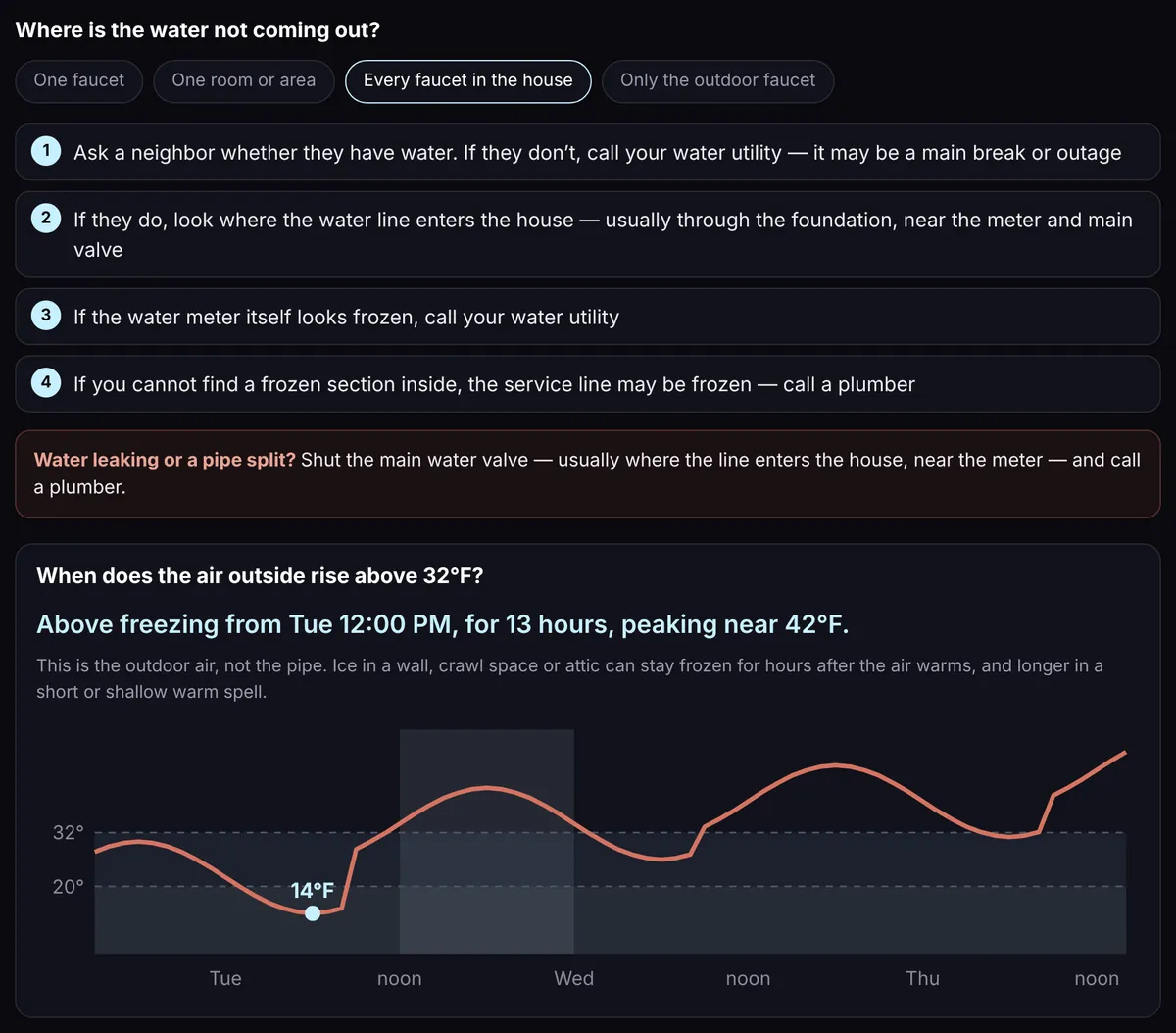
The second tab starts with one question: where is the water not coming out? One faucet or one room points to a pipe near that fixture, along an outside wall or through an unheated space, and the steps start there: leave the faucet open, find the cold section, warm it with a hair dryer, an electric heating pad or towels soaked in hot water, then check the other faucets. No water anywhere sends you to a neighbor first — if they are dry too, it is the utility’s problem — and then to where the line enters the house near the meter. A leak or a split pipe means shutting the main valve before anything else.
Below that, the same forecast answers the question people ask once the taps go dry: when does the air outside rise above 32°F, and for how long? In one test run the answer read “Above freezing from Tue 12:00 PM, for 13 hours, peaking near 42°F”, with that window shaded on a temperature line that runs at least three days ahead and always reaches the end of the window it names. If the forecast never rises above freezing, the page says so and names the warmest hour — that is the signal that waiting is not a plan. If an hour is missing from the forecast before the first warm hour, the page gives no time at all, because a warm spell could be hiding in the gap.
Why 20°F, and what the calculator will not guess
The 20°F line comes from field tests by the Building Research Council at the University of Illinois, published by the Insurance Institute for Business & Home Safety: uninsulated pipes in an unheated attic started to freeze when the outdoor temperature fell to 20°F. IBHS wrote that threshold for homes in the South, where pipes are less protected, and notes that a draft through a gap in an outside wall can freeze a pipe at warmer temperatures. Homes built for cold winters protect most of their plumbing, which is why the calculator asks where your pipes run instead of treating the whole house alike.
Wind and the number of cold hours appear on the cards but do not change any answer: the sources give no wind speed or duration the calculator could point to. It does not estimate the temperature inside your walls or the minute a pipe will freeze or thaw. The forecast and alerts load live from the National Weather Service each time you open the page, and the row of check marks above the cards shows which parts arrived.
Sources: IBHS, “Freezing and Bursting Pipes” (Building Research Council, University of Illinois); American Red Cross, Preventing and Thawing Frozen Pipes; FEMA, Winterizing Your Home; Connecticut Department of Housing, cold weather advisory; Virginia Beach Public Utilities, pipe winterization; City of Columbus Division of Water; Fort Wayne City Utilities; Bellevue Utilities; Detroit Water and Sewerage Department, winter tips; forecast and alerts: National Weather Service API. Built by Vitalii C.